
Aku wa Sonzai Shinai | dir: Ryusuke Hamaguchi | Japan | 106 mins
Ryusuke Hamaguchi’s latest film is a slow-paced environmentally themed tone poem that’s superficially straightforward yet expressively resonant. His follow-up to 2021’s compendium Wheel of Fortune and Fantasy and arthouse hit Drive My Car, this is more compact but no less emotionally impactful. It’s a beautiful, melancholic and unsettling experience.
The film is centred around Takumi (Hitoshi Omika), an odd-job man living in the woods at the edge of the small town of Mizubiki, a short drive from Tokyo. Takumi lives with his daughter Hana and leads a tranquil life; an odd-job man and a solid and respected member of the local community. When a company, Playmode, wants to build a glamping site at the edge of the village the residents are concerned about the potential environmental damage. Their confidence is further dented by the unconvincing responses from Takahashi (Ryuji Kosaka) and Mayuzumi (Ayaka Shibutani) at a community consultation meeting. Takumi will play a reticent yet pivotal liaison between the two reps and the local community.
From its synopsis alone, this could be a blunt and straightforward drama about the small community holding out against the big developers. But Evil Does Not Exist is something more delicate and thoughtful.
Unsurprisingly from Hamaguchi, it takes its time. The opening scene is a long tracking shot through the forest, gazing upwards at the sky filtered through the canopy. It extends for several minutes with minimal credits, accompanied by a soundtrack of strings, a lyrical passacaglia with a hauntingly calm melody, only occasionally wandering into a foreboding dissonance. This overture’s unhurried pace calms the audience into the film’s slow tempo, at least until it ends abruptly, jolting the audience.
Much of the first half of the film depicts the community and its relationship with nature. Lengthy shots of Takumi gathering water by a stream and carrying the plastic gallon water bottles uphill to the parked jeep with a neighbour, surrounded by autumnal forest. Takumi quietly chopping firewood outside his house with a chainsaw and axe. Takumi and Hana walking home from school, naming tree species. There’s a strong sense of pastoral calm. Arguably the film would still get its surface point across in much shorter, more efficient sequences, but by taking time we get into the rhythm and routine, so we the audience aren’t just tourists (like the developers) but we inhabit the scenes with the individuals on screen.

We also get to meet some of the others in the community; a community that depends on the land and on one another, and that has found peace in this forested idyll. It’s conveyed subtly. Hana collects bird feathers for the village elder to be used to pluck harpsichord strings, a local restaurant using spring water to steam noodles with pride.
But amidst this tranquillity, Hamaguchi signals a poetic potential violence. Gunshots from a deer hunt sound in the distance. And Takumi observes that the skeletal remains of a wild deer on the forest floor was ‘gut-shot’, shot in the stomach, a condition that can cause the animal to uncharacteristically attack humans in contrast to its normally timid behaviour. It’s a subtle way of highlighting how the community relies on nature, but also how nature can be dangerous when damaged by man, it’s all about balance.
Playmode, with its intended tourist development, is likely to upset that balance. The awkward consultation meeting at the town hall is a masterful sequence, depicting the community cohesion and bonding, and making the unglamorous topic of the location of a buried septic tank almost as thrilling as a courtroom drama. And it also introduces the idea that none of the community have permanence, the town is relatively young and so all are newcomers to an extent, giving a broader sense that the people don’t have a stake of entitlement over nature.
Although the boss is depicted as stereotypically crass, manipulative and profit-driven (it’s a mercifully brief single misstep in this film), the two representatives who visit Mizubiki to inform and convince the locals about the proposals are fleshed out and complex. There’s humour here – not just in their city-dweller fish-out-of-water situation, but also in their characters and their work relationship. Our first impressions are the same as the villagers at the unsuccessful consultation meeting in the town hall, but Hamaguchi then allows us to get to know them better, notably in a long car journey. Their surprise and discomfort at the community response is obvious and causes both to question the ethics of their involvement. And it’s clear both are lacking personal fulfilment, and they glimpse some inspiration in the town they are trying to convince. Just as we’re given time to absorb the village and its surroundings, Hamaguchi uses the lengthy containment of a car journey to expose us to this pair’s long, rambling conversations that help us to understand them.
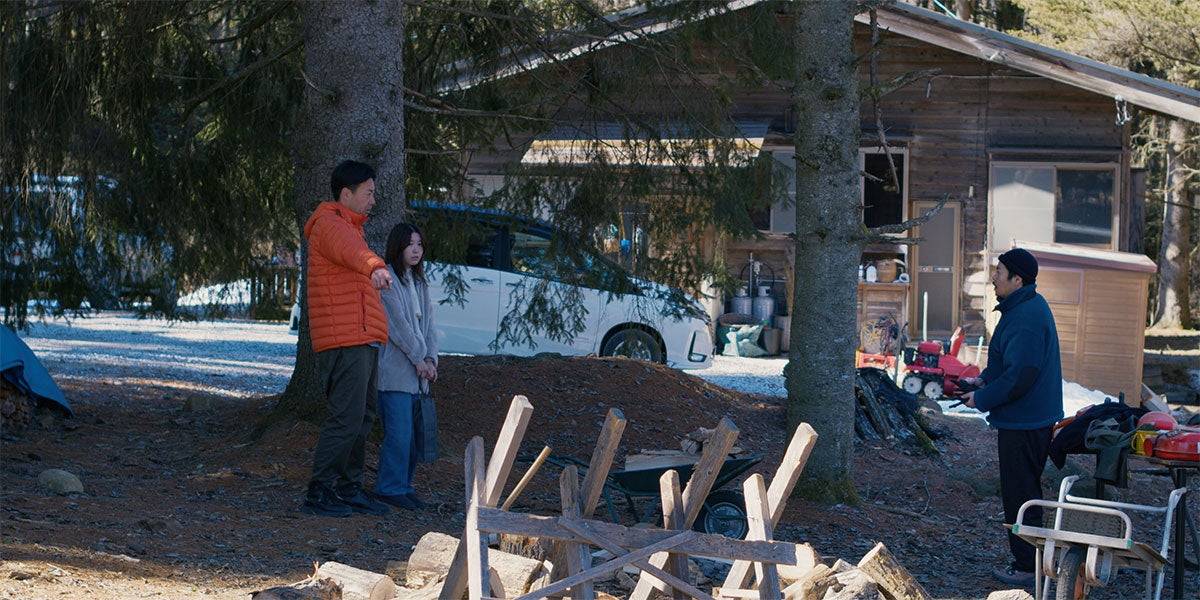
At around half-way Hamaguchi’s structure becomes clear, as some of the lengthy shots or sequences that filled much of the first portion of the film are revisited after Playzone’s intrusion. But these variant scenes have a subtle dissonance, there’s a sense of imbalance and threat in contrast. Often the camera movements are identical – notably a couple of beautiful long tracking shots with the protagonists walking right-to-left in the distance, partly obscured by trees – but the tone or the context are different, and we are given the subtlest of signs of foreboding or discomfort. None more so than in the character of Hana, Takumi’s daughter, notionally a side character to the main action, she’s an innocent presence, fragile and exposed to imminent changes.
The soundtrack that so effectively set the opening mood is by Eiko Ishibashi, an interesting Japanese musician who has previously worked with Japanese noise musician Merzbow and whose 2023 electronic ambient duo album ‘Lifetime of a Flower’ with Tokyo resident Jim O’Rourke I’d strongly recommend. In this film, the music uses more traditional instrumentation, mostly chamber orchestra strings with traditional harmonic structures and melody with just some occasional electronic layering. It’s ethereal and tranquil, and works supremely well. She also composed the soundtracks to Drive My Car and Hamaguchi’s next film Gift which seems to be a companion piece to this film, a half-hour dialogue-free contemplation using much of the same footage and scenario. That’s due to premiere in October at the Ghent Film Festival and it’ll be interesting to see how this more minimal variation compares.
Evil Does Not Exist is likely to frustrate some viewers, it’s slow and often mysterious. Its message and tone are poetic rather than spelled out, although the plot is straightforward and the characters well-formed and engaging. It’s also smaller in scope compared to some of Hamaguchi’s lengthier films. But for me its subtlety and disconcerting beauty won me over.
Evil Does Not Exist showed to the London Film Festival in October 2023.
 Dave's film blog