
dir: Todd Haynes | USA | 113 mins
Todd Haynes’s latest film is a queasy melodrama with darkly comic moments and leaves an unsettled aftertaste.
This is his first since Carol for which Haynes didn’t write the screenplay – he was approached by Natalie Portman with a suggestion to pick up screenwriter Samy Burch’s and Alex Mechanik’s original story, itself loosely based on a real-life 1990s scandal – but it still exhibits his distinct authorial hand with moments of camp and a fascination with identity. It has its flaws, but it’s a fascinating and disconcerting work.
Julianne Moore plays Gracie, an aging mother who gained tabloid notoriety and a prison sentence for having an affair with a 13-year-old boy when she was in her mid-thirties. Twenty years later, she’s since released and married to the boy Joe (Charles Melton), now himself in his thirties, living a comfortable live in a close-knit community on an island off the California coastline. The couple are soon to be empty nesters as their youngest children, twins, are on the cusp of leaving home for college.
Their idyllic lifestyle barely disguises the fallout from the past; Gracie’s son by her former marriage (a nonchalant Cory Michael Smith) was classmates with his stepfather Joe, which causes fragmentation. The family still receive the occasional anonymous shoebox of shit in the mail. And, it’s revealed, Grace’s cake-making business is barely a side-hustle supported by the neighbours out of sympathy rather than as a going concern. Gracie herself, while presenting a warm exterior, seems barely able to hold things together emotionally in private.
The past is brought back by Portman’s character Elizabeth, an actress chosen to play Gracie in a biopic movie. Portman is researching her character by spending some time with Gracie and the family something that the older woman appears to guardedly welcome. And it’s this curious relationship that forms the centre of Haynes intriguing film.
There are unmissable and deliberate echoes of Bergman’s Persona in how Portman creepily seems to morph into Gracie’s character (Haynes has also cited Bergman’s Winter Light as an influence on an impressive late scene where Portman, against a neutral backdrop, voices one of Gracie’s love letters). Haynes fins inspiration in how to invoke a distanced fascination with his two protagonists and how they echo one another, rather than directly copy the mysterious psychological depths of Bergman’s masterpiece.
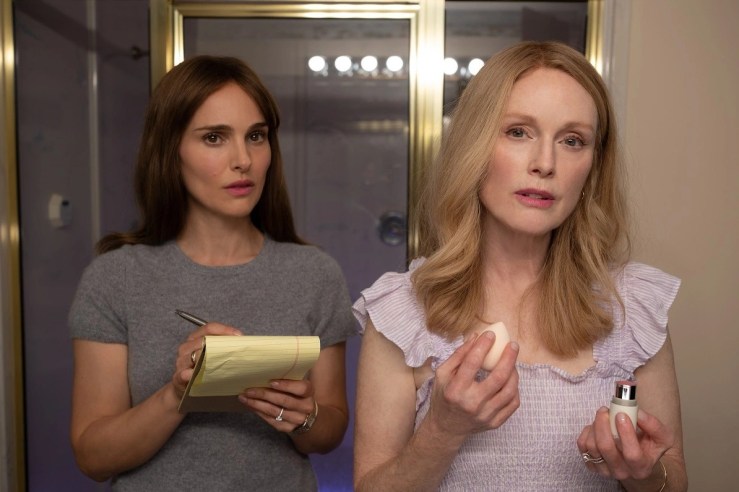
In May December the two women are fascinatingly unlikeable, increasingly so as we gradually get to know them better. While Haynes uses Elizabeth’s research to gradually reveal the couple’s characters and backstory, Elizabeth’s own disturbing fascination with Gracie becomes more manifest and subtly creepy, as if she wants to actually become Gracie to a level more than just demanded by her acting assignment. It’s a slow build, most impressive in a focused scene where Gracie demonstrates her make-up regime as Elizabeth at first studiously takes notes until Gracie decides to apply her blusher and distinctive magenta lipstick to Elizabeth herself, carefully crafting a human replica of herself as if smoothing the icing of a birthday cake. In turn, Elizabeth is later seen with the same shade of lipstick, similar clothing, hair and eventually even body language, a quietly obsessive mimic.
There are several scenes where the two women are placed side by side impassively staring at the camera, at us. A disconcerting yet unshowy breaking the third wall that seems to challenge the audience to judge. Mirrors abound also, echoing the theme of what is true and what merely a reflection.
Curiously, Haynes has chosen a soundtrack that repurposes Michel Legrand’s score to Joseph Losey’s The Go Between. The overbearing piano-and-orchestra music dominates almost every scene, it’s insistent piano motif creates a heightened sense of drama and significance that sometimes heightens the mood and sometimes plays against it to comic effect (notably in an early scene when Gracie worries that she hasn’t bought enough hot dogs for the barbeque). It lends the film a curiously heightened yet distanced tone, almost anachronistic and unmodern; the score is a foreign country, they do things differently there.
In interviews Haynes said the soundtrack was played aloud on set when shooting virtually every scene without dialogue, the camera and actors moved in response to its pulse. He caught a screening of Losey’s film on TCM a few months before pre-production and immediately knew it was right for his movie, and it seems it was an instinctual decision. Even so, May December has a thematic link with that earlier film in which a young boy, also thirteen, has his sexual innocence shattered, and anyone familiar with Losey’s film can’t help but recall its sunny nostalgic disquiet.
The film’s look is equally distinctive. Christopher Blauvelt, Kelly Reichard’s regular cinematographer, was recruited only two week’s before pre-production to step in for Hayes usual cameraman Edward Lachman after he suffered an injury. Blauvelt gives the film a matte, milky luminance, the gentle tones and grainy texture suggest a calm domesticity that belies the disturbing undercurrents. The shallow-focus means often much of what’s on camera is slightly soft, though not quite negative space, just as the audience can’t quite get a sharp understanding of the two protagonists. Many reviewers have highlighted Haynes choice of zoom shots, often combined with on-screen movements, suggesting a campy aesthetic; I’m less convinced of that suggested intent, for me the unfashionable choice of zooms suggest, like the soundtrack, a distant time as well as reinforcing to the audience of the artificiality and unknowing distance of a reconstruction.
The film is set in 2015, presumably to avoid the messiness and distraction of including more contemporary political focus about group identity and victimhood. By contrast, this is a film about blurred individual identity and ambiguity around manipulation and exploitation, without once shying away from the troubling truth that the married couple’s relationship was based on paedophilia, statutory rape and exploitation.
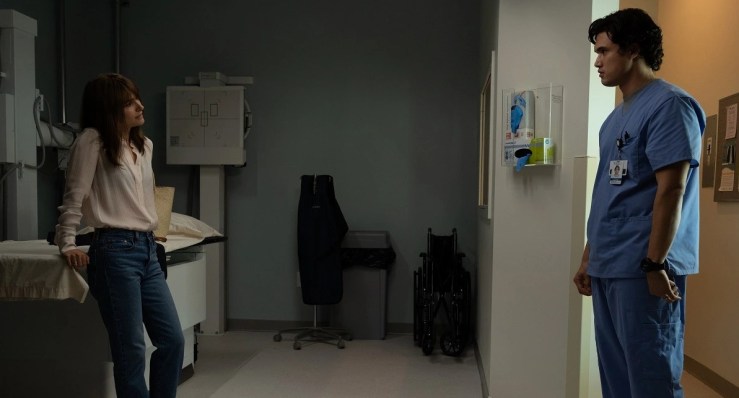
Part way through our sympathies turn to Joe. A 34-year-old man child, manipulated and exploited in different ways by both women. First seen obediently manning the barbeque, in time he hesitantly emerges from his chrysalis, fumbling towards self-revelation and existential doubts. Haynes places the triggers for that emergence carefully. A pot-influenced conversation with his teenaged son, himself on the cusp of emerging into the world prompting Joe to reflect on his own stunted entrapment. Elizabeth’s seductive manipulation that releases a sense of agency and desirability.
But in the end it’s the children we feel sorry for, damaged or distanced by the defective foundation of their family, the fallout visible and brought into focus by Elizabeth’s fascinations. Like Haynes Safe and even more so the still-banned Superstar: The Karen Carpenter Story this is a film that explores dysfunctional family secrets and societal malaise and queasy fame.

May December showed at the London Film Festival (following its Cannes debut) and was on general release in the UK on 17th November.
 Dave's film blog