
Yeohaengjaui pilyo | dir: Hong Sangsoo | South Korea | 90 mins
Hong Sangsoo’s latest film is a peaceful comedy drama that left me reflecting long after the end credits began. It has a wonderful central performance from Isabelle Huppert, who plays an enigmatic outsider in South Korea – the ‘traveler’ whose enigmatic intrusion prompts emotional resonance with those she encounters. Hong expresses this in his characterisation and in his stylistic choices. Comic and contemplative, it’s a delight.
Centring around Iris (Isabelle Huppert), it’s a contemplation of communication and an individual’s often suppressed need to communicate their essential feelings unbounded by the strictures of social convention. Iris herself remains something of a mystery although she’s in every scene; it’s the curious impact she has on the people she encounters that’s at the heart of this film.
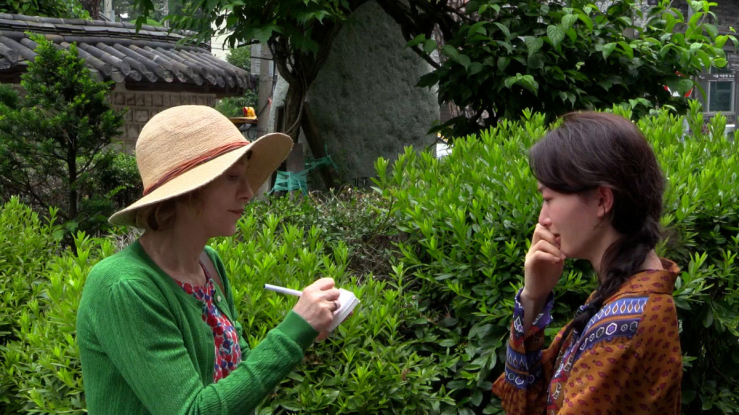
Hong paints Iris in minimalist brushstrokes, her backstory is unclear and her future plans and motivations, if any, opaque. Instead, she’s presented as a character fully in the immediate present, an inspires an immediacy in emotional connection.
An older French woman who seems recently to have settled in South Korea without a solid means of income, she uses her creativity to develop an openly experimental method of teaching French as a foreign language that both prompts unsurprising scepticism and unexpected emotional engagement, leaving the people she encounters contemplating the truths they discover about themselves because of the unusual transactional arrangements.
This is a very funny film, much of it drawn from Huppert’s character and performance. Fish-out-of-water scenarios typically concern the individual’s responses to an unfamiliar environment; Hong instead draws great humour from other characters’ (and the audience’s) response to a very unfamiliar individual.
Huppert’s comic performance is wonderful, the 71-year-old actor plays Iris almost as a child, with odd behaviours, a disarming directness and a happy carefree attitude that seems entirely untethered to adult norms. She plays Iris with a seemingly naïve confidence that charmingly dominates every encounter, and Huppert’s often physically comic performance inhabits entirely Hong’s scripted situations and dialogue.
Iris’s enigmatic character dominates the film. A free spirit, the audience is as charmed and amused by beaming smile, her quirks, flirts and her excessive praise, as the other characters are. She somehow floats. But Hong doesn’t encourage an unforgiving eye; we remain slightly wary of her, she’s something of a charlatan too.
The main characters she interacts are sufficiently charmed to accept some very personal questions and she makes people feel understood, even though we’re shown there something of a formula to the technique she’s developed. However, Iris also has a parasitic fragility, with her traveller’s needs for shelter and sustenance are immediate, and we suspect her emotional needs for belonging and acceptance.
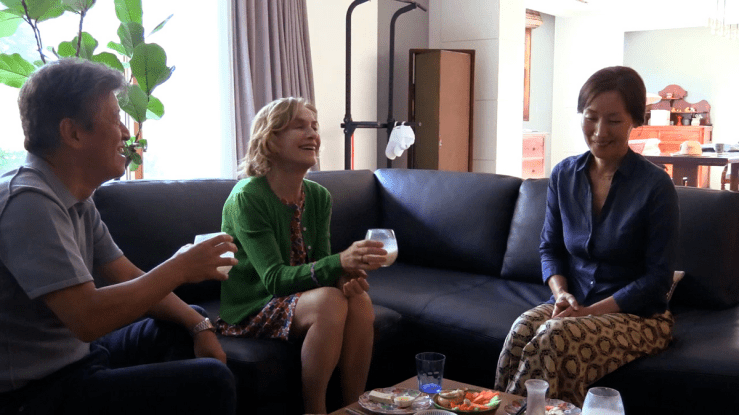
The presence of Huppert in A Traveler’s Needs, her third collaboration with Hong Sangsoo, allows the director to add an extra layer to his regular theme of essential communication. Playing a French woman adrift in South Korea, her linguistic and cultural distinction from her chosen environment makes her character a curiosity with a license to ask disarmingly direct questions, but also allows Hong to use language as a direct expression of communication and the lack of it.
He plays with three languages: French (she’s teaching her native language), Korean (which Huppert doesn’t seem to understand although an unguarded reaction to being offered lunch suggests perhaps she has some knowledge), and English, the shared language. In a couple of scenes, some Korean poetry is translated for Iris into English, not French.
Hong of course uses his trademark long takes, occasional camera pans and zooms. The latter is stylistically unfashionable in today’s cinema and so is often mildly disconcerting and could feel almost amateurish, as if the action has unexpectedly moved outside the frame and needs a corrective action, but there’s a precision in his camera placement and coverage.
A curious moment when Iris chooses to cross a stream starts with a shot of just the stream and her legs cut off at the knees, it’s all we need to understand her pause to contemplate the problem, deciding to cross barefoot and tentatively edging forward, and Hong holds that shot for a long time before eventually zooming back to include her full height.
Colour is used expressively, and Iris is strong associated with green, a freshness, natural, essential colour, contrasting with the beige of many characters’ lives, clothes, and décor. The vibrant green of her shawl and even the tape around her pen, but also in the colour of the outdoor roof terrace above a flat with its green floors and parapet, and the subtly in the interiors – a green lamp and tints in the curtains signalling her territory. But the place she really belongs is in the outdoors: the tree-clad mountain side, crossing that stream surrounded be green grasses on a park bench surrounded by the lush foliage of the park as she atonally plays a child’s recorder.
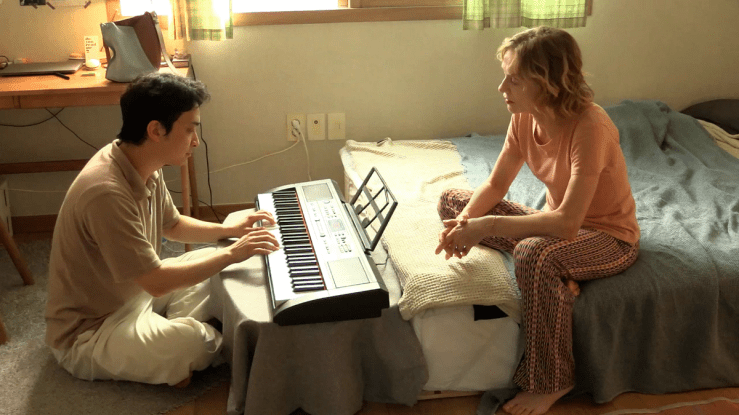
Music is the film’s fourth language. One student plays Liszt on piano, a second reaches for guitar, another character plays piano. All of them struggle with the technical limitations of their musical skills and ego-driven aims for a conventional perfection to express themselves fully. Contrast that with Iris’s technically awful but freely self-expressive squeals from her recorder playing.
As usual Hong uses repetition, scenarios and dialogues repeat, sometimes almost word-for-word, but in a fresh variation, either for the participants or for the audience’s understanding. It also adds to the contemplative tone of this film; the scenes are slow and undynamic yet always interesting, and Hong’s control of pace has him playing with time.
This is a light, almost ethereal film. Often very funny and engagingly enigmatic, this meditation on communication and emotional needs is a delight.


Hi, I’m just wondering how to get to you to review a couple of my films that are releasing in January 2025. 😉 I wonder if you’d be interested to do so.
LikeLike
Hi Jules. Sorry I missed your message before Christmas – I expect I’m probably too late as we’re now in February, but let me know if now. Thanks for the approach. Dave
LikeLike